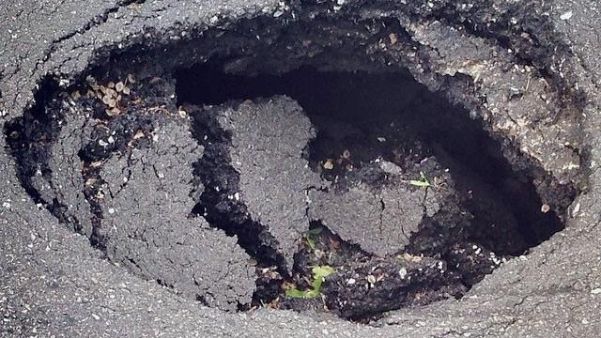
| Have you ever been driving and hit a major crack or dip in the street?
As our daughter would say, “That’s a bad asphalt patch.” Yes, we start them young around here.
The reality is that it is probably not the asphalt patch that is failing, but rather the trench was likely not filled with any or enough flowable fill.What is flowable fill you may be asking yourself? Valid question…
When excavating in the street or alley, the dirt in the trench is dug up and hauled away. Once the new sewer pipe is properly bedded and connected, the trench will be filled with flowable fill.
Flowable fill is delivered on a mixer truck and has similar ingredients to concrete, but it isn’t concrete. Instead, the cement, sand, water and fly ash combine to create a sturdy substitute for traditional fill that is also sometimes called controlled low-strength material (CLSM).
Because it flows into place, flowable fill requires no compaction. Its viscosity and strength can be altered to meet the needs of any backfill projects, and its fluidity allows it to flow long distances to even the hardest to reach places.
Some other advantages include:
- No settlement – Flowable fill does not form voids during placement, and won’t settle or rut under loading. This advantage is especially significant if the backfill in a utility trench is to be covered by a pavement patch.
- Easy to deliver – Ready-mix trucks can deliver specified quantities of flowable fill to the job site whenever the material is needed.
- Improves worker safe – Workers can place flowable fill in a trench without entering the trench, reducing their exposure to possible cave-ins.
- Allows fast return to traffic – Because flowable fill can be placed quickly and can support traffic loads within several hours, it minimizes road closures for pavement repairs.
- Strong and durable – Load-carrying capacities of flowable fill typically are higher than those of compacted soil or granular fill.
- Can be excavated – Flowable fill, having a compressive strength of less than 150 psi, is excavatable with conventional excavating equipment, yet is strong enough for most backfilling needs.
- Allows all-weather construction – Flowable fill will displace standing water left in a trench from rain or melting snow, eliminating the need for dewatering pumps.
Why is this important to you?
If you are hiring a company to work in your street or alley, you need to make sure that they are planning to use flowable fill to backfill the trench before patching the concrete or asphalt. Failure to do so could result in a significant sink hole that is a safety concern. The patch would need to be dug up and re-done, resulting in unnecessary time and money spent.
Any questions? Give us a call – we are always happy to help! 303-562-9800 |